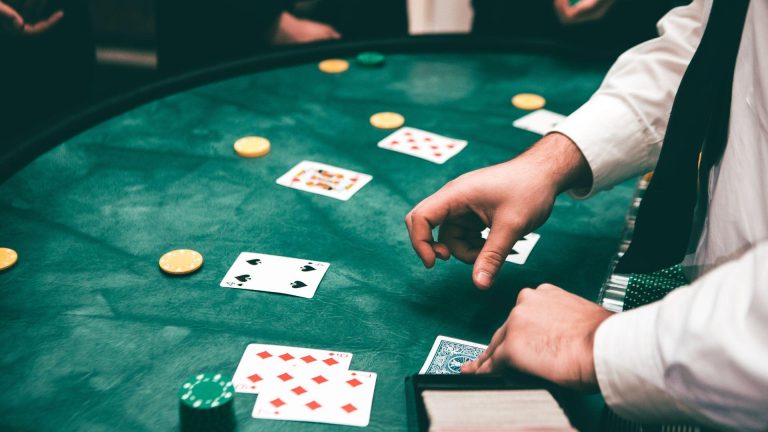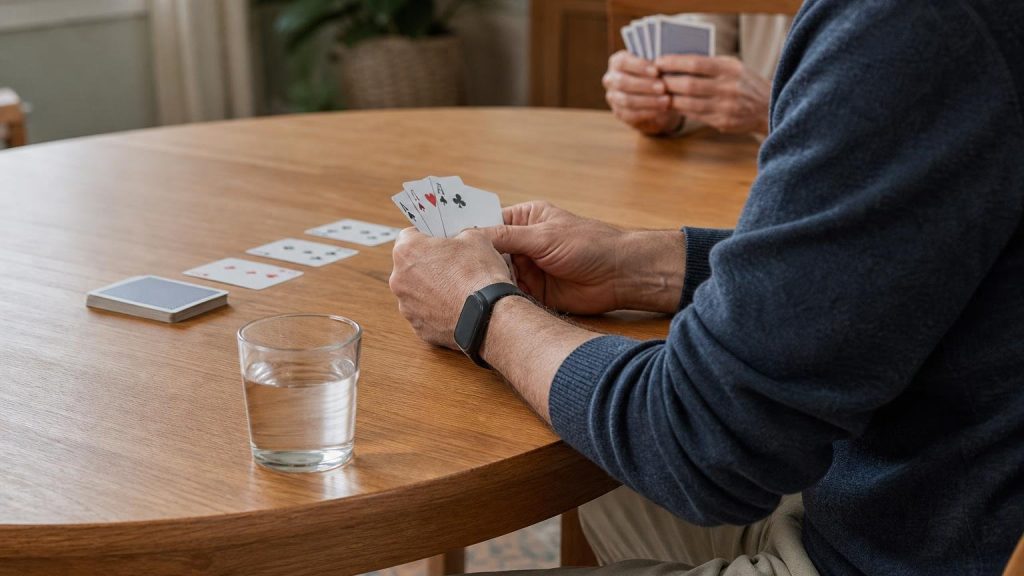
Four hours of seated card playing could account for roughly 420 calories in a 70 kg (154 lb) adult. Taken alone, that figure gives a misleading impression of the activity’s demands: quiet sitting would account for about 280 calories over the same period. The difference matters when logging activity or interpreting a fitness tracker. A session total includes the energy required to keep the body functioning, not just expenditure associated with handling cards or following the game.
The Reference Value Behind the Estimate
The 2024 Adult Compendium of Physical Activities lists seated card playing at 1.5 metabolic equivalents, or METs. One standard MET approximates the energy cost of sitting quietly.
This category does not distinguish individual card games, tournament conditions or playing styles. For someone seated while viewing live blackjack ontario, the reference offers a starting point for estimation, not a measured calorie cost specific to online play. Posture, duration and movement remain the relevant considerations.
The Adult Compendium covers ages 19–59; separate resources address older adults. Its figures should not be presented as equally validated across all ages.
Where money is involved, eligibility matters as much as estimation. ToonieBet, operated in Ontario by Canadix Limited under an iGaming Ontario agreement, offers live blackjack among more than 3,000 casino games, with play restricted to adults 19 and over who are physically in Ontario. Time and spending limits should be set beforehand, and a calorie estimate is no reason to prolong gambling or chase losses.
Calculating Expenditure Without Counting Time Twice
The simplified calculation is:
Estimated calories = MET × body weight in kilograms × hours
At 1.5 METs, one hour produces an estimate of 90 calories for a 60 kg (132 lb) adult, 105 calories at 70 kg, and 120 calories at 80 kg (176 lb). Convert pounds to kilograms by dividing by approximately 2.205.
Duration should reflect the activity being estimated. If a two-hour period includes ten minutes of walking, calculate 110 minutes of seated play and ten minutes of walking separately. Counting two full hours of play and then adding the walk would duplicate those ten minutes.
An oxygen-based conversion used by some calculators produces results about 5% higher than this simplified convention. Neither method measures personal metabolism; displaying more decimal places does not resolve the underlying uncertainty.
Choosing the Right Comparison for TDEE
For a 70 kg adult, four hours of card playing at 1.5 METs yields 420 calories. Subtracting quiet sitting at the Compendium’s 1.0-MET reference leaves a modeled difference of 140 calories.
That is only one comparison. Seated desk work carries a reference value of 1.3 METs, equivalent to about 364 calories over four hours for the same adult. If card playing replaces desk work, the calculated difference is 56 calories rather than 140.
These comparisons answer different questions from a session total. They also depend on standardized values: one MET is not necessarily equivalent to an individual’s measured resting expenditure. Age and body composition contribute to variation.
Total daily energy expenditure, or TDEE, already includes resting expenditure and daily activity. Adding all 420 calories to an existing TDEE estimate would count resting energy twice. Even the 140-calorie difference could overlap with activity already represented in the calculator’s daily allowance. It is not an automatic allocation for additional food.
What Concentration and Wearables Can Establish
Mental fatigue provides little basis for assigning additional calories. In a Laval University study published in 2007, 15 healthy female students completed either 45 minutes of seated rest or a reading-and-writing task. Energy expenditure differed by approximately three calories.
The sample was small and the task academic. Its findings cannot quantify a card tournament’s demands, but they illustrate why perceived effort should not be substituted for a metabolic measurement.
Wearable validation presents a related distinction. A 2017 study tested seven wrist-worn devices in 60 volunteers during sitting, walking, running and cycling. None achieved energy-expenditure error below 20% under that evaluation. Those results concern the tested devices and conditions, not a universal error rate for current trackers.
Stress can raise pulse without corresponding muscular activity. An accurate heart-rate reading therefore does not establish an accurate calorie estimate, particularly during low-movement activities.
Sitting Guidance Applies to the Whole Day
At 1.5 METs, seated card playing falls within the consensus definition of sedentary behavior: low-energy waking activity performed sitting, reclining or lying down.
US guidance recommends moving more and sitting less, with 150–300 minutes of moderate aerobic activity weekly and muscle strengthening on at least two days. It specifies no universal sitting-break schedule.
The Canadian guidelines for adults aged 18–64 recommend eight hours or less of sedentary time daily, including no more than three hours of recreational screen time, and interrupting long sitting periods as often as possible.
Physical card games count toward seated time, but not automatically screen time. These recommendations encompass work, transport and leisure together. Walking breaks should be recorded separately; seated play does not contribute to moderate-intensity exercise targets.